

The AWS Model for Energy: How Data Centers Could Make Residential Electricity Free
Inside the Creative response that transforms tech's biggest liability into America's greatest energy opportunity

“Hyperscalers could meet one third of their projected additional capacity needs by paying for heat pumps in select households that currently use inefficient electric heating, cooling, and water heating, thereby creating capacity on the grid... Hyperscalers could more than meet their total planned capacity needs by paying for battery storage as well as rooftop solar for homes well suited for it.”
— Rewiring America, “Homegrown Energy” Report, September 2025 [1]
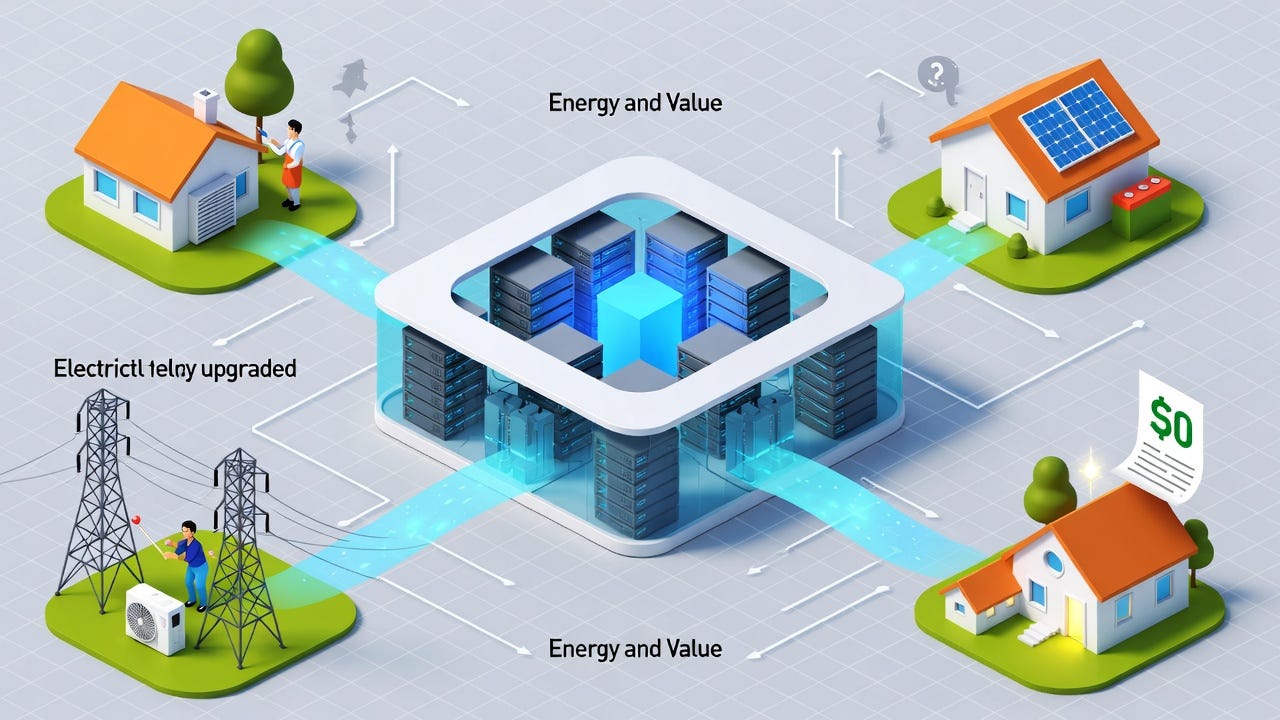
The False Choice
On Tuesday, I laid out the paradox: $64 billion in data center projects blocked while electricity prices climb twice as fast as inflation. Both sides claim moral high ground—communities defending their wallets, hyperscalers defending American AI leadership.
Both are right about the problem. Both are wrong about the solution.
The moratorium camp treats data centers as inherently parasitic—extracting community resources for corporate benefit. The “just build” camp treats community concerns as impediments to progress. Neither recognizes that the same economics making data centers problematic could make them transformative.
Today I’ll show you the creative response—one that’s already emerging in Mississippi, Virginia, and a dozen other states while the debate rages elsewhere.
The Real Diagnosis
The data center energy debate fails because it asks the wrong question: “How do we minimize data center harm?”
The right question: “How do we capture data center surplus?”
Here’s the insight everyone misses: data centers generate more economic value from energy than they consume. The issue isn’t that they use too much electricity—it’s that the surplus value flows to shareholders instead of communities.
Consider the math:
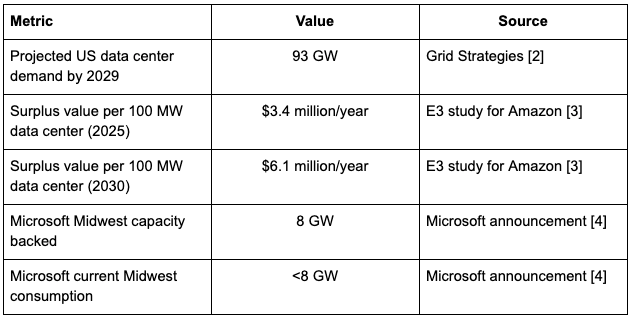
Microsoft is building more generation capacity than it currently needs. Google just paid $4.75 billion for an energy infrastructure company. [5] Amazon generates millions in surplus value that utilities can use for grid modernization.
The hyperscalers are already overbuilding energy capacity. The question is: who captures the excess?
The Three Responses Compared
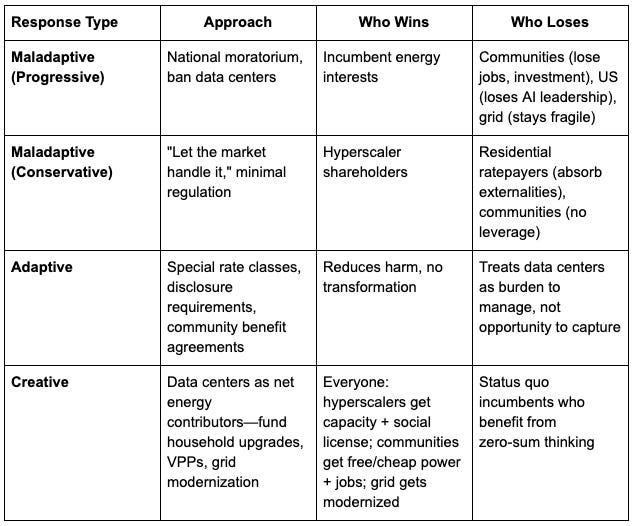
Let me address both Maladaptive camps directly.
The Progressive Maladaptive Case: Senator Sanders calls data centers “a threat to democracy.” [6] The Working Families Party wants candidates to run explicitly against data center construction. [7] Food & Water Watch gathered 230 organizations demanding a national moratorium. [8]
Their diagnosis is correct: communities shouldn’t subsidize trillion-dollar tech companies. Their solution is wrong: stopping data centers doesn’t stop AI demand—it offshores it to countries with weaker environmental protections and no community benefit requirements whatsoever. China isn’t holding town halls about data center placement.
The Conservative Maladaptive Case: “Just let the market work” ignores that markets don’t exist in regulatory vacuums. Permitting delays, interconnection queues, and zoning restrictions are the constraint. xAI can write a check for 500 megawatts of gas turbines, but they still need air permits. [9] Pure market rhetoric without permitting reform is magical thinking.
Moreover, without community buy-in, markets face political backlash. Virginia’s data center politics have already tipped elections. [10] “Build faster” works only if communities don’t revolt—and they’re revolting.

The DeepSeek Paradox: Why China's AI Efficiency Breakthrough Still Loses to American Infrastructure
The Creative Response: Four Pathways
The creative response doesn’t ask communities to sacrifice for AI progress or ask AI to sacrifice for communities. It asks: how do we structure arrangements where data centers make communities wealthier?
Pathway 1: The Homegrown Energy Model
Ari Matusiak, CEO of Rewiring America, has proposed the most comprehensive framework for hyperscaler-funded household energy transformation. [11]
The insight is simple: the fastest way for hyperscalers to get grid capacity isn’t building new power plants (7+ year timeline) or fighting interconnection queues. It’s freeing up existing capacity by making households more efficient.
The Numbers:
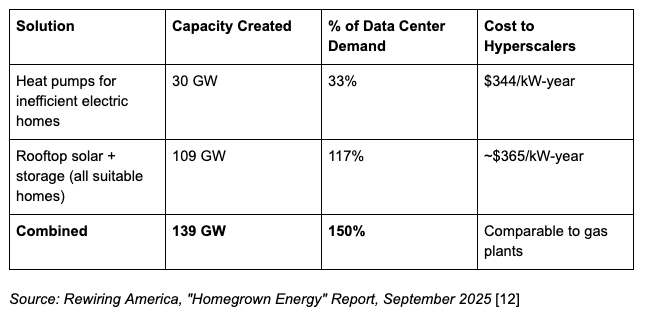
If hyperscalers paid for half the upfront cost of heat pump installations in homes with inefficient electric resistance heating, they could secure grid capacity at roughly $344/kW-year—comparable to building a new gas plant at $315/kW-year. [13]
But here’s the difference: the gas plant only benefits the hyperscaler. The heat pump upgrade benefits the household forever.
Household benefits from hyperscaler-funded upgrades:
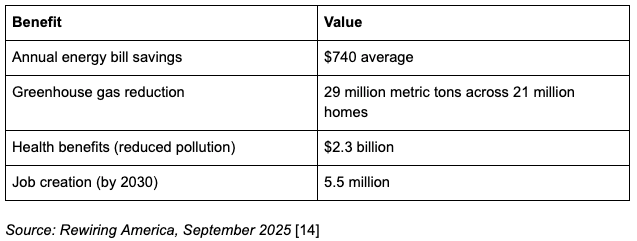
The Volts podcast recently convened Matusiak with Carla Peterman, PG&E’s sustainability lead, to explore implementation. [15] The response from hyperscalers? According to Rewiring America: “What we’ve heard consistently is that hyperscalers are excited by solutions that don’t just meet their load requirements but also deliver visible benefits to the communities hosting them.” [16]
This isn’t charity. This is enlightened self-interest. Hyperscalers need social license to build. Communities blocking $64 billion in projects demonstrate that “build and ignore externalities” no longer works.
Pathway 2: The Virtual Power Plant Play
On a recent Volts episode, Seth Frader-Thompson of EnergyHub outlined how data centers could fund VPPs that create dispatchable capacity for entire regions. [17]
VPPs aggregate distributed resources—home batteries, smart thermostats, EV chargers—into grid assets that can respond to utility dispatch commands. EnergyHub already manages 2.5 million devices representing 3.5 GW of capacity.
The “Huels Test” for VPP maturity: Can your VPP convince a grid operator that it’s a power plant?
Currently, most VPPs are Level 0-2: basic demand response with limited dispatchability. Level 3-4 VPPs would function as full grid resources—schedulable, dispatchable, with real-time telemetry matching traditional generation.
Data center integration opportunity:
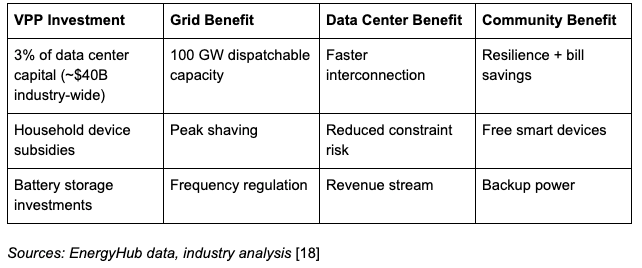
Voltus has already launched a “Bring Your Own Capacity” product allowing data centers to fund distributed energy in their communities, aggregate it into VPPs, and use the capacity credits to offset their own requirements. [19] It’s the beginning of data centers as grid assets rather than grid liabilities.

Pathway 3: The Mississippi Model—Surplus as Grid Investment
Entergy Mississippi’s “Superpower Mississippi” demonstrates the simplest version of hyperscaler-as-benefactor: large industrial customers generate enough revenue surplus that utilities can fund massive grid investments without raising residential rates.
Superpower Mississippi by the Numbers:
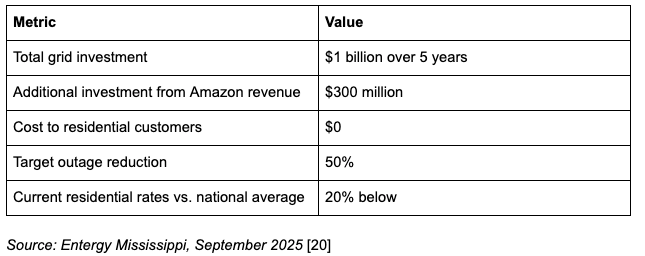
CEO Haley Fisackerly explained the logic: “We were facing a moment where the growth in our service area was not moving as quickly as our projected costs, which would have resulted in significant rate increases. The solution we needed—and found—was to attract growth to our service area in the form of a large customer that could help share in the costs to serve all our customers and bring down future costs for everyone.” [21]
This inverts the moratorium movement’s entire premise. Data centers aren’t raising Mississippi electricity bills. They’re funding the infrastructure that makes electricity cheaper and more reliable for everyone.
Pathway 4: The AWS Endpoint—Energy as a Service
Here’s where it gets speculative but logical.
Amazon Web Services exists because Amazon built computing overcapacity for holiday retail peaks, then monetized the excess year-round. The accidental discovery became a $100+ billion business.
Hyperscalers are now building energy overcapacity for AI reliability. Microsoft backed 8 GW in the Midwest—more than current consumption. [22] Google acquired an energy infrastructure company. [23] Amazon is deploying 4.2 GW of firm carbon-free energy across four states. [24]
The excess capacity exists. The question: what happens to it during off-peak hours?
Possible endpoints:
Grid services revenue: Data centers provide frequency regulation, voltage support, demand response during off-peak hours. Revenue flows back to offset community electricity costs.
Waste heat utilization: Meta’s Odense facility already heats 11,000 homes. [25] Every data center produces waste heat. District heating integration could eliminate heating costs for surrounding communities.
Energy arbitrage: Data centers with on-site generation and storage can buy cheap off-peak power, store it, and sell expensive peak power—with community benefit agreements sharing the arbitrage profits.
The full flip: Communities negotiating hosting agreements that guarantee rate reductions or elimination as a condition of approval.
This last endpoint sounds radical. But consider: if a 100 MW data center generates $6.1 million in annual surplus value by 2030, and your community is 10,000 homes, that’s $610 per household per year in potential value capture. Average residential electricity bills run around $1,500/year. [26]
The math supports demanding substantial—even total—rate relief as a community benefit.
Why America Is Uniquely Positioned
The creative response isn’t available everywhere. It requires what I call America’s three superpowers working in concert.
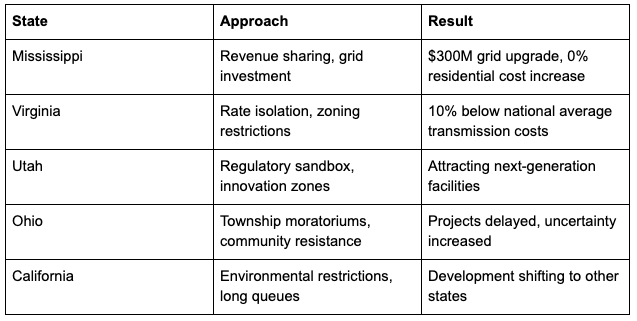
Federalism as laboratory: States can experiment with different data center benefit structures. Mississippi chose utility revenue sharing. Utah is exploring sandbox regulatory approaches. [27] Texas might try competitive energy markets with data center VPP mandates. Virginia is testing disclosure and zoning requirements.
No federal moratorium can match this experimental diversity. When Mississippi’s approach generates better outcomes than California’s restrictions, the lesson spreads. When one state overreaches, capital flows elsewhere rather than offshore.
The State Laboratory Evidence:
Mobility as selection pressure: Companies and capital can relocate. States that structure community-benefit deals attract investment. States that ban data centers lose both the problems and the opportunities to competitors. This isn’t a threat—it’s how federal systems discover optimal policies.
Free speech as correction mechanism: The moratorium movement itself demonstrates American adaptability. Communities organizing, politicians responding, policies adjusting—this is the error-correction process that authoritarian systems lack. China can build data centers faster because communities can’t object. America builds them more sustainably because communities can demand better terms.
International Comparison
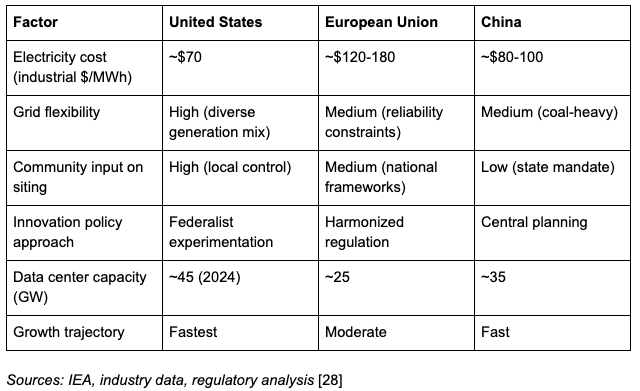
America’s electricity advantage persists even amid data center growth. The combination of cheaper power, regulatory flexibility, and community voice creates conditions for discovering optimal arrangements that neither pure market nor pure planning can achieve.
Framework Applied
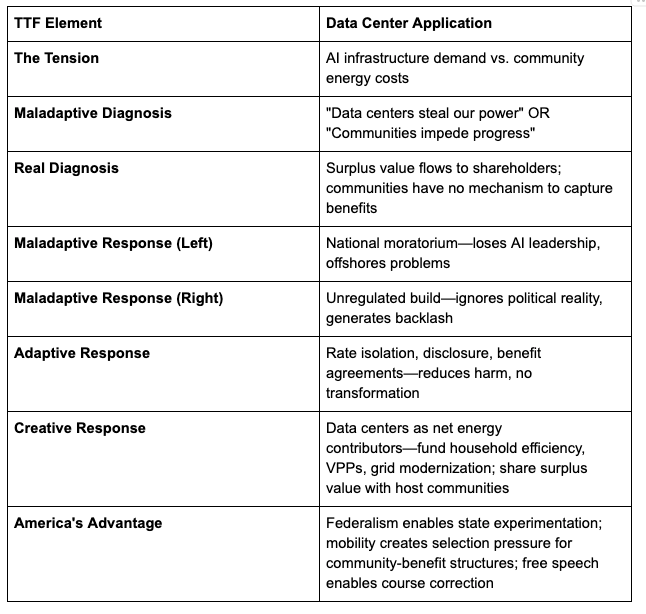
So What? Practical Implications
For business leaders considering data center investments:
The “build fast, ignore externalities” era is over. $64 billion in blocked projects demonstrates the political constraints. Microsoft’s “Community-First AI Infrastructure” initiative isn’t philanthropy—it’s recognition that social license determines buildability. Structure deals with explicit community benefit or face Virginia-style political backlash.
For state policymakers:
You have leverage. Hyperscalers need sites, power, and community acceptance. Use that leverage to negotiate benefit-sharing structures—not to block development, but to ensure development benefits your constituents. Mississippi’s model: data centers fund grid improvements at zero cost to residential customers. Demand no less.
For community advocates:
The moratorium movement has correctly identified that current arrangements are unfair. But “stop building” cedes the opportunity to capture benefits. Reframe the demand: not “no data centers” but “data centers that make our electricity cheaper—or free.” The math supports aggressive asks.
For the politically homeless:
This debate exemplifies how victim mindset (data centers are stealing from us) and savior mindset (we’ll force communities to accept progress) both fail. The architect mindset asks: how do we structure arrangements where everyone benefits? The answer exists. The question is whether we have the political will to pursue it.
What Comes Next
The hyperscaler energy surplus will be captured by someone. The question is whether that someone is shareholders, communities, or some combination.
States that structure community-benefit deals will attract investment and popular support. States that ban data centers will lose both the problems and the opportunities. States that allow unregulated development will face political backlash that reverses gains.
The moratorium movement is a signal, not a solution. It signals that current arrangements are unacceptable. The creative response channels that signal toward arrangements that benefit everyone.
Amazon accidentally invented AWS by monetizing computing overcapacity. Hyperscalers are now building energy overcapacity. The communities smart enough to demand a share of that surplus will prosper. The communities fighting zero-sum battles will watch opportunities flow elsewhere.
The question isn’t whether to allow data centers. It’s what you demand in return.
Chris Wasden, EdD, has spent four decades at the intersection of technology and strategy, from Wall Street M&A at JPMorgan to leading healthcare innovation at PwC to building medical device companies to academic research on complex adaptive systems. He currently serves as Chief Strategy Officer at Dario Health. Chris describes himself as “politically homeless”—too data-driven for ideologues on either side.
#DataOverDogma
Subscribe for Tuesday/Thursday analysis applying the Tension Transformation Framework to America’s most contentious issues.
Endnotes
[1] Rewiring America, “Homegrown Energy: How household upgrades can meet 100 percent of data center demand growth,” September 2025. https://www.rewiringamerica.org/research/homegrown-energy-report-ai-data-center-demand
[2] Grid Strategies, “Strategic Industries Surging: Driving US Power Demand,” December 2024. https://gridstrategiesllc.com/wp-content/uploads/National-Load-Growth-Report-2024.pdf
[3] Energy and Environment Economics (E3), study commissioned by Amazon, December 2025. Cited in Amazon corporate blog, “Data Centers don’t raise your electricity bills.” https://www.aboutamazon.com/news/sustainability/data-centers-electricity-bills-grid-power-amazon
[4] Brad Smith, Microsoft announcement, January 13, 2026. https://interestingengineering.com/culture/microsoft-ai-infrastructure-water-power
[5] Fierce Network, “Hyperscalers have a new build vs buy dilemma: electricity,” January 2026. https://www.fierce-network.com/cloud/hyperscalers-have-new-build-vs-buy-dilemma-electricity
[6] Senator Bernie Sanders, Senate floor statement, December 2025. Cited in Introl Blog and The American Prospect.
[7] Heatmap News, “Data Centers Are the New NIMBY Battleground,” September 26, 2025. https://heatmap.news/plus/the-fight/spotlight/data-center-conflicts
[8] Food & Water Watch letter to Congress, cited in The American Prospect, December 22, 2025.
[9] xAI Memphis facility analysis based on public filings and reporting.
[10] Fortune, “A grassroots NIMBY revolt is turning voters in Republican strongholds against the AI data-center boom,” December 16, 2025.
[11] Ari Matusiak, Utility Dive op-ed, “Why data center operators should pay for residential electrification upgrades,” October 10, 2025. https://www.utilitydive.com/news/household-electrification-demand-data-center/760817/
[12] Rewiring America, “Homegrown Energy” report, September 2025.
[13] Ibid., citing RMI gas turbine cost analysis.
[14] Rewiring America, “Homegrown Energy” report and follow-up jobs analysis. https://www.rewiringamerica.org/research/data-centers-job-growth-homegrown-energy
[15] Volts podcast, “Could we get hyperscalers to buy heat pumps for households?” October 2025.

[16] Wael Kanj, Rewiring America research manager, quoted in Utility Dive, December 2025.
[17] Seth Frader-Thompson, EnergyHub CEO, Volts podcast interview, January 21, 2026.
[18] Industry analysis combining EnergyHub data, Amazon E3 study, and Voltus announcements.
[19] Voltus “Bring Your Own Capacity” product launch, cited in Energy Changemakers, October 2025. https://energychangemakers.com/electric-demand-from-ai/
[20] Entergy Mississippi, “Superpower Mississippi” program details. https://www.entergymississippi.com/superpowerms
[21] Haley Fisackerly, Entergy press release, September 24, 2025.
[22] Microsoft Community-First AI Infrastructure announcement, January 13, 2026.
[23] Google acquisition of Intersect for $4.75 billion, December 2025.
[24] Amazon carbon-free energy deployment, cited in Amazon corporate blog, December 2025.
[25] Meta Odense district heating integration widely documented in European energy publications.
[26] U.S. Energy Information Administration, average residential electricity bill data, 2024.
[27] Utah regulatory sandbox approach documented in previous Substack analysis on AI energy.
[28] International Energy Agency; industry data; regulatory comparison analysis.